Introduction
용도 | 복합시설
층수 | B1F-23F
Program | mix-used
Floors | B1F-23F
Agenda
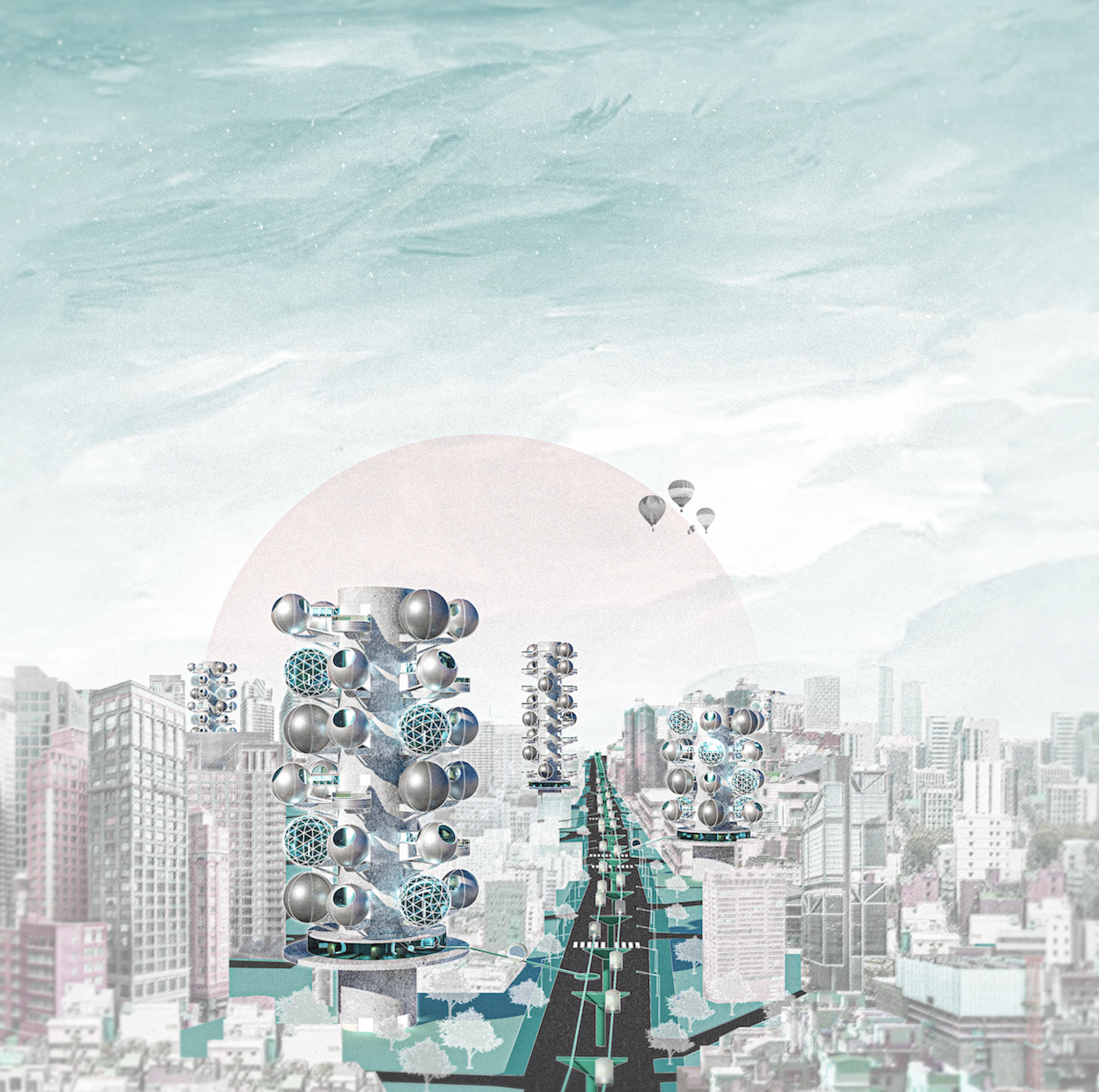
인류는 태초부터 유목민이었다. 현대사회는 또다시 삶의 방식과 가치관에서 유목적 사고를 수용하고 있으며, 이젠 자연이 아닌 도심 속을 표류하고 있다. 인류가 진화함에 따라 도시 구조 또한 비정주적으로 진화하고 이동이 하나의 거주 양식이 될 것이다.
플랫폼은 철도 유휴부지를 통해 연결되어 도시 전체에 분포된다. 이것은 노마드의 다핵적 네트워크를 형성하여 하나의 도시를 이루며, 지속 가능한 생태계를 형성해 준다.
Humanity has been nomadic from the beginning. Modern society is once again embracing nomadic thinking in lifestyles and values, drifting through urban landscapes rather than nature. As humans evolve, urban structures will also evolve non-sedentarily, with mobility becoming a way of life. Platforms are connected through disused railway, dispersing across the entire city. This forms a multi-nucleated network of nomads, creating a sustainable ecosystem.
Concept


600만 년의 역사 중 정착민으로 산 기간은 5,000년 정도, 고작해야 0.1%에 지나지 않는다. 인류는 노마드의 DNA를 갖고 있다. 최근 공간의 제약 없이 자유롭게 일하는 디지털 노마드가 등장했고, 코로나 사태가 종식된 후에도 꾸준하게 그 수가 증가하고 있다.
근미래에 이동 수단이 자율주행화됨에 따라 업무공간은 모빌리티와 결합하고, 이는 디지털 노마드를 위한 움직이는 워크스테이션이 되어 도심 속을 표류하게 될 것이다.
도시 곳곳에 분산되어 가상 세계에서 소통하는 이들에게, 물리적 소통의 소멸을 막고자 디지털 노마드를 위한 아날로그 플랫폼을 제안한다.
Throughout its 6-million-year history, humanity has settled as sedentary beings for only about 5,000 years, a mere 0.1% of that time. Humans have the DNA of nomads. Recently, digital nomads have emerged, and their numbers continue to grow steadily even after the end of the COVID-19.
In the future, as transportation becomes autonomous, workspaces will integrate with mobility, creating MOBILE WORKSTATION for digital nomads to drift urban spaces. For those who are distributed throughout the city and communicate in the virtual world, I propose an analog platform for digital nomads to prevent the disappearance of physical communication.
Site


서울시 지상철도 지하화 관련 계획이 발표됨에 따라, 근미래에 새로운 유휴부지가 될 지상 철도를 이용하였다. 기존 고가도로의 거대한 철로를 제거하고 기둥만을 보존한 후, 모빌리티를 위한 레일을 설치한다. 사이트는 철도 유휴부지 옆 어디든 위치할 수 있다.
With the recent announcement of plans to underground Seoul’s above-ground railways, new unused land will soon be created from the current railway lines. The large rail structures of the existing elevated tracks will be removed, leaving only the supporting pillars, and new mobility rails will be installed. The site can be located anywhere adjacent to this unused railway land.
Design


유목의 DNA를 가진 비정주적 도시는 상황에 맞게 변화한다. 따라서 도시 전체에 분포된 플랫폼은 마치 유기체처럼 여러 가지 유닛의 조합으로 그 기능이 결정되고 시간과 공간에 따라 다양한 형태를 가지게 된다.
플랫폼은 Residence(R), Culture(C), Office(O), Leisure(L) 네 가지 유닛의 조합으로 그 기능이 결정된다.
Nomadic cities, inheriting the DNA of mobility, adapt to their surroundings. Thus, platforms dispersed throughout the city operate like organisms, their functions determined by combinations of various units and assuming diverse forms over time and space.
The platform’s functionality is determined by combinations of four units: Residence (R), Culture (C), Office (O), and Leisure (L).
Program

모빌리티는 진입층을 통해 플랫폼에 진입하게 된다. 이는 잠시 정차하는 사람들을 위한 공간이며, 플랫폼에 체류할 노마드는 리프트를 통해 모빌리티 층에 도착하게 된다. 바닥판이 회전하여 모빌리티는 원하는 주거 유닛과 결합하게 되고, 모빌리티에서 내려 계단을 통해 보행층으로 갈 수 있다. 층 사이 남는 공간들은 모빌리티 창고로 활용된다.
Mobility enters the platform via the entry level. This is for people stopping for a while, while nomads who will be staying on the platform will arrive at the mobility level via a lift. The floor plates rotate to allow the mobility to engage with the desired dwelling unit, and the nomad can exit the mobility and take the stairs to the pedestrian level. The remaining space between floors is utilized for mobility storage.
Drawings


credit